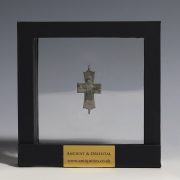
Byzantine Enkolpion Reliquary Cross of The Virgin Mary and Evangelists
£ 300.00
A very fine half of a Byzantine bronze enkolpion reliquary cross featuring a low-relief depiction of Mary Orans and the Four Evangelists. A stylised image of the Virgin Mary composes the centre of the cross, depicted wearing a tunic and maphorion. The Virgin is depicted in the orant prayer pose with her arms raised upwards, a thin halo surrounds her head. Four busts, most likely representing Matthew, Mark, Luke and John, each occupy an arm of the cross. Remnants of a hinged base and a suspension loop feature at the foot and the top respectively. They would have originally joined the reverse half of the cross and aided in personal adornment. This piece features an attractive dark patination to the surface and is mounted in a custom frame.
Dimensions of the cross: circa L 7cm x W 4cm
Date: Circa 10th - 12th Century AD
Provenance: Ex German art market, 2000s. Acquired from an EU collector living in London. From the collection of a Surrey, UK, gentleman.
Condition: Fine Condition. Repair to the top arm of the cross. Due to its age, much of the surface has worn away, resulting in indistinct details across the faces. Some tarnishing and scratching to the surface. Please note, the cross is attached to the frame.
In stock
Enkolpia were small pendants worn around the neck, with examples found dating back to Late Antiquity. The cross shape was the most popular symbol for such amulets, as a symbol of Christianity, believed to have apotropaic qualities. Many enkolpia were designed to hold reliquaries, as can be seen here by the opening function of the pendant. The reliquary was believed to work in tandem with the talismanic qualities of the cross-shape to protect the wearer from harm and evil. The popularity of these reliquary enkolpia suggests that not all held primary relics such as a piece of the True Cross or a bone of a Saint, but likely held secondary relics, for example earth from a holy site, locks of hair, or cloth touched by a saint. They were made in an assortment of materials, from gold and silver, to bronze and lead. Worn as a talisman and a symbol of the owner’s faith, such pieces were very popular in Byzantium, providing an intimate look at the material culture of piety in the Byzantine Empire.
To discover more about Byzantine art, please visit our relevant blog post: The Byzantine Empire, Art and Christianity.