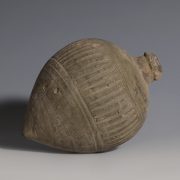
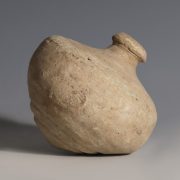
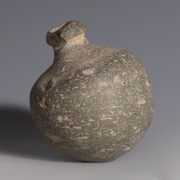
Byzantine Conical Hand Grenade
£ 260.00
A Byzantine earthenware hand grenade featuring an elongated conical body with a flat base terminal. To the top, the vessel leads to a short neck and splays out slightly into a thick rim with a small mouth. This allowed the item to be filled with an explosive liquid known as ‘Greek fire’ and used as a hand grenade in battle. The mouth would have also accommodated a fuse to instigate the explosion. The grenade is adorned with three vertical ridges which extend from the neck to the mid/lower body. The ridges would have been used for a better grip.
Date: Circa 9th-11th century AD
Provenance: From a collection of a North London gentleman, latterly with a London gallery.
Condition: Good condition, earthy encrustations remain on the surface. Some chips on the body. Minor residue on the body.
In stock
Greek Fire, also referred to as liquid fire (ὑγρόν πῦρ, hygron pyr), was one of the most famous weapons of the Byzantine arsenal and its use played a crucial role in the defence of the Empire, ensuring its long survival. The formula for the flammable mixture was closely guarded for centuries and irredeemably lost after the collapse of the Empire. Its precise composition thus remains unknown to this day, though research suggests that petroleum was a vital ingredient making the liquid impervious to water. Greek fire was first used at sea where it was particularly effective against wooden ships; it was later delivered via clay grenades, either by hand or by launching with a catapult.
To find out more about Byzantine hand grenades please see our relevant blog post: Byzantine Fire Grenades.