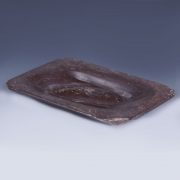
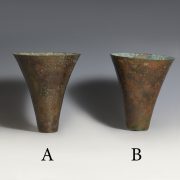
The Sasanians succeeded the Achaemenids, establishing an Empire which, at its peak, expanded from the Euphrates to the Indus Rivers. Sasanian art borrowed from Near Eastern and Greco-Roman traditions and adapted the significance of these cultures’ iconography to the local repertoire.
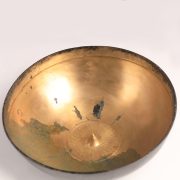
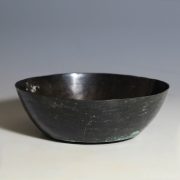
In the Iron Age Mediterranean, handless and footless bronze bowls featuring hemispherical containers and curved profiles were richly ornamented with Greek and Etruscan motifs. In Greek times, such bronze bowls, sometimes with elaborately decorated figural and zoomorphic ornaments, were known as ‘phiale mesomphalos’ (ϕιάλη μεσόμφαλος). They are believed to have been used as a cremation container or a dedicatory offering in ancient Greece, in accordance with Homer’s literature. However, bronze bowls of this kind originated in the ancient Near East. Differing from the Greek and Etruscan parallels that were normally used for religious occasions, ancient Near Eastern bronze bowls were used by the elite as a daily luxurious object.