Ancient Egyptian Blue Faience Anubis Amulet

£ 350.00

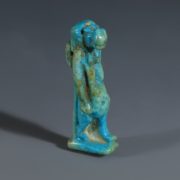
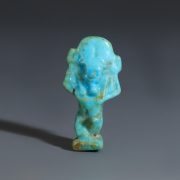
An ancient Egyptian amulet in blue glazed faience, moulded in the form of Anubis. The deity is shown striding with his left leg forward, as he keeps his elongated arms stiff at his sides. Such a stance, known as the ‘left foot forward’ stance, is one of the oldest standing figure types in Ancient Egyptian art. Later adopted and developed in Ancient Greece, it set the basis for the evolution of dynamism in sculptural art. A tripartite wig frames his zoomorphic face, flowing down his back into the pillar he rests against. The identity of the deity is clear from the large, pricked ears and square snout. He also wears a short, shendyt kilt, striated as is usual. The reverse of the amulet features a small hole for suspension behind the shoulders, however it is now blocked.

Date: 664–30 BC
Period: Late Period–Ptolemaic Period
Condition: Very fine condition. Some encrustation and wear, consistent with age.

In stock

SKU: LD-1063 Category: Tags: , ,

Anubis was an important deity within the Egyptian pantheon. He was represented as a canine-headed man, most likely a jackal. He was depicted from the Early Dynastic Period solely as a jackal. The association with the dead existed from this period, as Anubis was known as a protector of graves. Jackals were a common feature of Early Dynastic necropolis’s, whose shallow graves were frequently foraged by the wild animal. From the Old Kingdom, Anubis was the primary god associated with the afterlife, however this changed from the Middle Kingdom, when Osiris become more popular. Anubis however was still associated with the afterlife – he was the god of embalming bodies until the Middle Kingdom, and had an important role in the transition between life and death. He ushered souls into the afterlife, and tended to the weighing scale during the Weighing of the Heart Ceremony– which determined whether a soul would be allowed to enter the realm of the dead.

To find out more about the Ancient Egyptian amulets please see our relevant blog post: Egyptian Amulets and their Meanings: Ancient Egyptian Gods.

Weight 5.76 g
Dimensions W 0.9 x H 4.1 cm
Culture

Egyptian Mythology

Faience

Region

Reference: For similar: The Metropolitan Museum, New York, item 2021.41.33

You may also like…