Ancient Egyptian Faience Nehebkau Amulet

£ 800.00

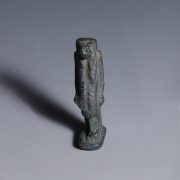
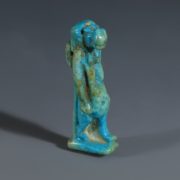
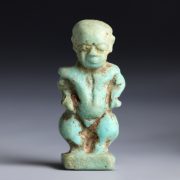
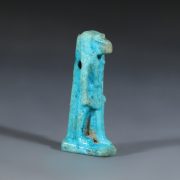
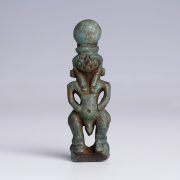
An ancient Egyptian, turquoise faience, amulet of the god Nehebkau. The deity is depicted seated upright on a stool, with a slender, long serpentine curved body and a slightly raised head. The god’s long head is met by two hands clasped together while the feet are tightly pressed together, bent at the knee in seated form. The god has a large eye that has been craved onto the statue, serpentine in nature, with hooded upper lids. There is a large loop at the top near the head for suspension.

Date: Circa 664-332 BC
Period: Late Period
Provenance: Ex English collection, AB, acquired 1920s-40, passed by descent.
Condition: Good Condition. Some discolouration and earthly encrustations on the surface, as expected for the age of the artefact.

In stock

SKU: RCB-26 Category: Tags: , , ,

Nehebkau was a chthonic god within the ancient Egyptian pantheon, represented as a snake or snake-headed man. Although originally considered an evil spirit, who simply emerged into being, he was later associated with the afterlife and the joining of spirits.

Nehebkau was listed as one of the forty-two assessors of Ma’at; lesser deities who were tasked with judging the deceased within the ‘Weighing of the Heart’ ceremony. The deities were each associated with a particular sin, which the deceased was supposed to declare he was not quilty of. Nehebkau was associated with arrogance. Nehebkau was ultimately considered a powerful, benevolent, and protective deity. In later mythology, he is described as a companion of the sun god Ra and an attendant of the deceased King.

To find out more about Ancient Egyptian amulets please see our relevant blog post: Egyptian Amulets and their Meanings.
Weight 1.24 g
Dimensions L 1.2 x W 0.4 x H 2.5 cm
Culture

Faience

Region

Reference: For similar: The Metropolitan Museum of Art, Item 89.2.540

You may also like…