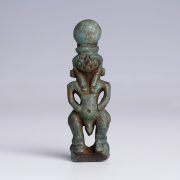
Taweret, also known as Tawaret or Theoris, was an Egyptian deity who attended women in childbirth, and became a patron for pregnant women accordingly. She is most often shown standing as a heavily pregnant hippopotamus with a low hanging stomach and . She was a household deity with no temple dedicated to her, but some form of shrine was in almost every house. Many women carried an amulet like this to assist them with labour and child rearing. From the new Kingdom onwards she was often depicted together with Bes, another apotropaic deity associated with women and children.
The Egyptians wore amulets alongside other pieces of jewellery. They were decorative, but also served a practical purpose, being considered to bestow power and protection upon the wearer. Many of the amulets have been found inside the wrappings of mummies, as they were used to prepare the deceased for the afterlife. Amulets held different meanings, depending on their type or form. Small amulets depicting gods and goddesses seem to have induced the protective powers of the deity, and these styles gained popularity from the Middle Kingdom.
To find out more about the Ancient Egyptian amulets please see our relevant blog post: Egyptian Amulets and their Meanings: Ancient Egyptian Gods.