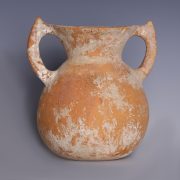
The Holy Land was the first region to enter the Bronze Age, which began with the rise of the Mesopotamian civilisation of Sumer in the mid-fourth millennium BC. The Bronze Age then went on to span an entire millennium. The presence of Canaanite vessels among the funerary offerings in the royal tombs of the First Dynasty of Egypt has revealed an important link between this period and the Early Bonze Age. These vessels have become a cornerstone in the chronology of the Near East in the Early Bronze period. Numerous other types of vessels are known from this area. Terracotta vessels from the Southern Levant area, such as this one, serves as important evidence for this region, highlighting the different cultural influences of its various occupants. The vessel may have been used for storage, although the handles suggest that the vessel was grasped in the hands, rather than lifted by them.


Holy Land Terracotta Jar with Ledge Handles
£ 295.00
A Holy Land terracotta jar featuring a globular body and two small ledge handles on each side. The vessel presents a wide, uneven mouth with a slightly flared rim, and a short neck. The curved ledge handles are situated on the upper section of the body. They are enriched with a gently crimped appearance along the edges, in the pushed-up ledge-handle style. The vessel sits on a flat, circular base. The terracotta is unglazed, highlighting the natural colourations of the material, now uneven due to ageing.
Provenance: From an important European, London and Geneva, collection, formed 1988
Condition: Very fine condition, surface scratches and encrustation consistent with age.
In stock
| Weight | 2230.3 g |
|---|---|
| Dimensions | W 27 x H 21.5 cm |
| Culture | |
| Pottery and Porcelain | |
| Region |