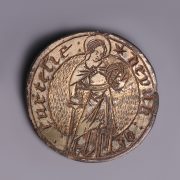
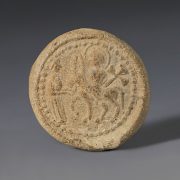
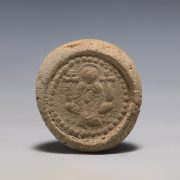
Saint Symeon of Stylites (386-459 AD) spent forty-two years atop a pillar at Sama’an, which was in his time a small village located on Lylon Mountain approximately 20 km south-west of Afrin, and forty kilometers north-west of Aleppo, Syria. He ate, slept, and did everything else in the open air, out where everyone could see him. When once he was asked why he was not ashamed he famously responded, ‘shame is a delusion since we are not alone, but always with God. ‘He spent most of each day standing atop his pillar, with his arms outstretched in a mode of worshipful faith and devotion to God. His ascetism made him famous around the world, and thousands of people joined him, congregated at the base of his pillar, and listening to his wisdom and unceasing prayers. The word ‘Sama’an’ means ‘Symeon’ in Arabic, and marks the place of the basilica which began to be built where the pillar of Saint Symeon once stood, even incorporating parts of the pillar itself into the Altar. After the Islamic Conquest the entire complex was converted into a military citadel.
Possessing such token of the Empire was not only a spiritual blessing and souvenir for the pilgrim, but also a ‘get-home-free’ pass to prove one’s Orthodoxy should one find oneself detained by imperial troops, at the time when Byzantine Empire was still fiercely persecuting and murdering Monophysite Christians.